
The Beginnings of Commercial Halloween
Tomorrow is Halloween, so for our last October Spooky Season post, I thought it would be fun to explore the history of Halloween as a commercial holiday. How did the holiday go from pagan festival to party time? And how did Gilded Age Halloween socials become children’s trick-or-treating?
With limited time, I don’t have full answers to these questions, but I did find some fascinating contemporary sources from the 1890s through the 1930s to illustrate how Halloween was celebrated in the early decades of commercialization. We’ll see some repeating themes throughout these contemporary accounts.
The Gilded Age - The Delineator, October 4, 1894
The Delineator was a women’s magazine published by the Butterick Publishing Company in New York City for the purpose of selling that company’s sewing patterns. The October 4th, 1894 edition of The Delineator details a Halloween party hosted by a Miss Isabel Cary in Selma, Alabama. The account begins with a tiny invitation rolled up inside a walnut shell, then goes on to describe elaborate decorations, dancing, and party games (many involving fortune-telling). Among the first decorations noted are apples hanging on strings from the ceiling. Apples make a another showing later in the evening with that perennial favorite, apple bobbing. Unsurprisingly for a party of young adults, a lot of the games involve coupling up. And unsurprisingly for the time period, there was a bit of a spiritualist bent to the games as well. Girls went “fishing” for a dance partner with a piece of string, looked in a mirror by candlelight in the hope of seeing their future partner’s face looming behind their shoulder, and burned nuts “by which heart futures are divined.”
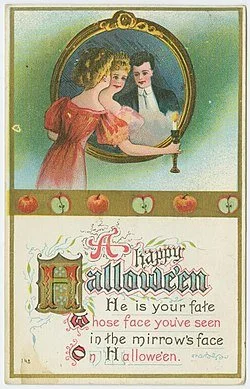
American trading card, c. 1890-1910. Wikimedia Commons.
1903 - Hallowe’en Festivities
The early part of the 20th century produced a lot of books about how to give them, d parties. In 1903, Edgar S. Werner & Company published the 31st volume of Werner’s Readings and Recitations titled Hallowe’en Festivities, authored by Stanley Schell. This short book offers games, entertainments, recipes, and decorating tips, recitations, and ghost stories. Performing seems to have been a big part of Halloween parties for several decades from the turn of the century on.
Like the walnut shell invitations seen in 1894, Schell suggests “conundrum nuts” as party favors. To make these, the party planner would hollow out a walnut shell, place a slip of paper inside with a riddle or joke on it, and glue the shell back together. We also see the “game” of looking into a candlelit mirror - this time while brushing your hair - to see the face of your future mate over your shoulder. Another way to see your future mate was to walk backwards down the cellar stairs holding a mirror which… seems like a bad idea? Some new games are introduced here as well. One, called Four Saucers is played like this:
“Place four saucers on the table in line. Into first put dirt; into second, water; into third, a ring; into fourth, a rag. Guests are blindfolded and led round table twice, then told to go alone and put fingers into saucer. If they put into dirt, it means divorce; into water, a trip across ocean; where ring is, to marry; where rag is, never to marry.”
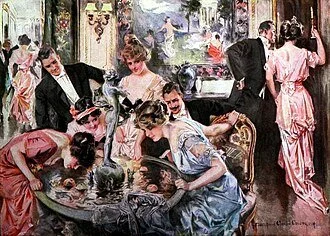
Howard Chandler Christy's painting "Halloween" as reproduced in Scribner's Magazine January 1916. Wikimedia Commons.
In another, the party host hides a ring, a thimble, and a penny. Whoever finds the ring will marry soon; the thimble means a single life, and the penny means wealth.
1915 - The Complete Hallowe’en Book by Elizabeth F. Guptill
Very similar in tone and content to the Schell book a decade earlier, The Complete Hallowe’en again provides ideas for games, decorations, plays, recitations, songs, and food. Here again, we see the familiar “old candle and mirror trick” for seeing your future partner by walking backwards down a flight of stairs holding a mirror (and this time also a candle! How did these people not fall to their deaths and burn down the house?!). On the same page is The Three Saucers, which replaces the dirt, water, ring, and rag with clear water, soapy water, and an empty saucer to represent a happy marriage, widowhood, and singledom respectively.
1931 - The Best Halloween Book by Lenore K. Dolan
In the same vein, 16 years later, The Best Halloween Book has the subtitle “Recitations, Dialogues, Plays, Exercises, Drills, Dances, Pantomimes, Songs, Games.” A full 80% of this one is taken up with performance material. This seems to be aimed at children’s parties, but we still see some of the same games. Just as in 1903 we saw the ring, thimble, and penny, in 1931 we see the Ring Cake. A ring, a thimble, a key, and a dime were baked into a cake to provide fortunes. The ring meant marriage, the thimble meant work, the dime meant wealth, and the key meant travel. Another throwback that has been altered is the apples hung from the ceiling at the 1894 party. By 1931 this had turned from a decoration into a game similar to apple bobbing, whereby children attempt to take a bite out of the hanging apple without touching it with their hands.
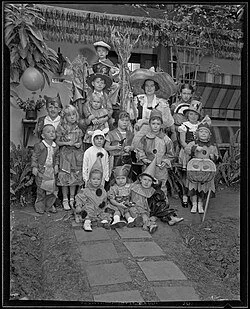
Children and an adult in Halloween costumes, circa 1935. Wikimedia Commons.
So, when you go to your Halloween party tomorrow, spare a thought for your ancestors singing, reciting, and divining their way through the night. And stay safe out there!
